By Rowan Ellis · Updated October 7, 2026
n8n alternatives for SaaS teams tired of running it themselves
The n8n alternatives SaaS teams most often weigh are Activepieces, which also self-hosts, Make and Zapier for a fully managed service, and Pipedream when the workflows are really code, with Workato for companies where a security review drives the buying. The reasons to leave are narrower than "n8n is hard": the hosted plans end at Pro, so SSO, Git version control and multiple environments only arrive on Business at $800 a month billed annually, which is self-hosted only; concurrency is capped at 5 on Starter; and the license limits what you can build for your own customers. Prices were read from each vendor's pricing page on October 7, 2026.
n8n is still the best-value engine in this list for long, branching workflows, because its page bills a whole run as one execution however many steps it has. So this page does not argue that you should leave. It shows where leaving makes sense, what you would pay at three volumes on each side, what the Sustainable Use License says about SaaS products, and how n8n's documentation says to export what you have built.
Why n8n teams look elsewhere
The good controls are not on the hosted plans. n8n's pricing page puts Starter ($20 a month billed annually, 2.5K executions) and Pro ($50, 10K executions) on n8n's own hosting. Business, at $800 a month billed annually for 40K executions, adds SSO and LDAP, multiple environments, queue mode, Git version control and 6 shared projects, and its card reads "Self-hosted only". Enterprise can be hosted by n8n or self-hosted, but it is contact-sales. A team that wants SSO and does not want to run servers has no published self-serve answer.
Running it is your job. The Community Edition is a standard self-hosted version available on GitHub, and Business is the same shape. The Server CLI, according to the command-line docs, runs on the same machine as n8n with direct database access, and covers backups and migrations. Those are tasks that fall to whoever owns the install, and a SaaS team that wanted automation to be one less thing to operate may reach this point and stop.
Ceilings come in steps. Concurrent executions are 5 on Starter, up to 50 on Pro and 200+ on Enterprise, and execution volume jumps from 10K on Pro to 40K on Business. The Pro and Business cards carry a drop-down selector, so other volumes may exist; we read only the defaults. Support is listed as forum support on Starter, and a dedicated SLA appears only on Enterprise.
No free hosted plan. The page offers a trial with no credit card for Starter and Pro, and the Business trial is self-hosted only. After that the cheapest managed option is $20 a month for a plan that covers 2,500 runs. Make, Zapier and Activepieces each publish a free tier.
Size and license fences. The Business card is described as for companies with fewer than 100 employees, and the page offers a Start-up Plan with 50% off Business to teams under 20 employees. Separately, the license restricts building customer-facing automation features, covered in its own section below.
The pricing page, captured October 2026
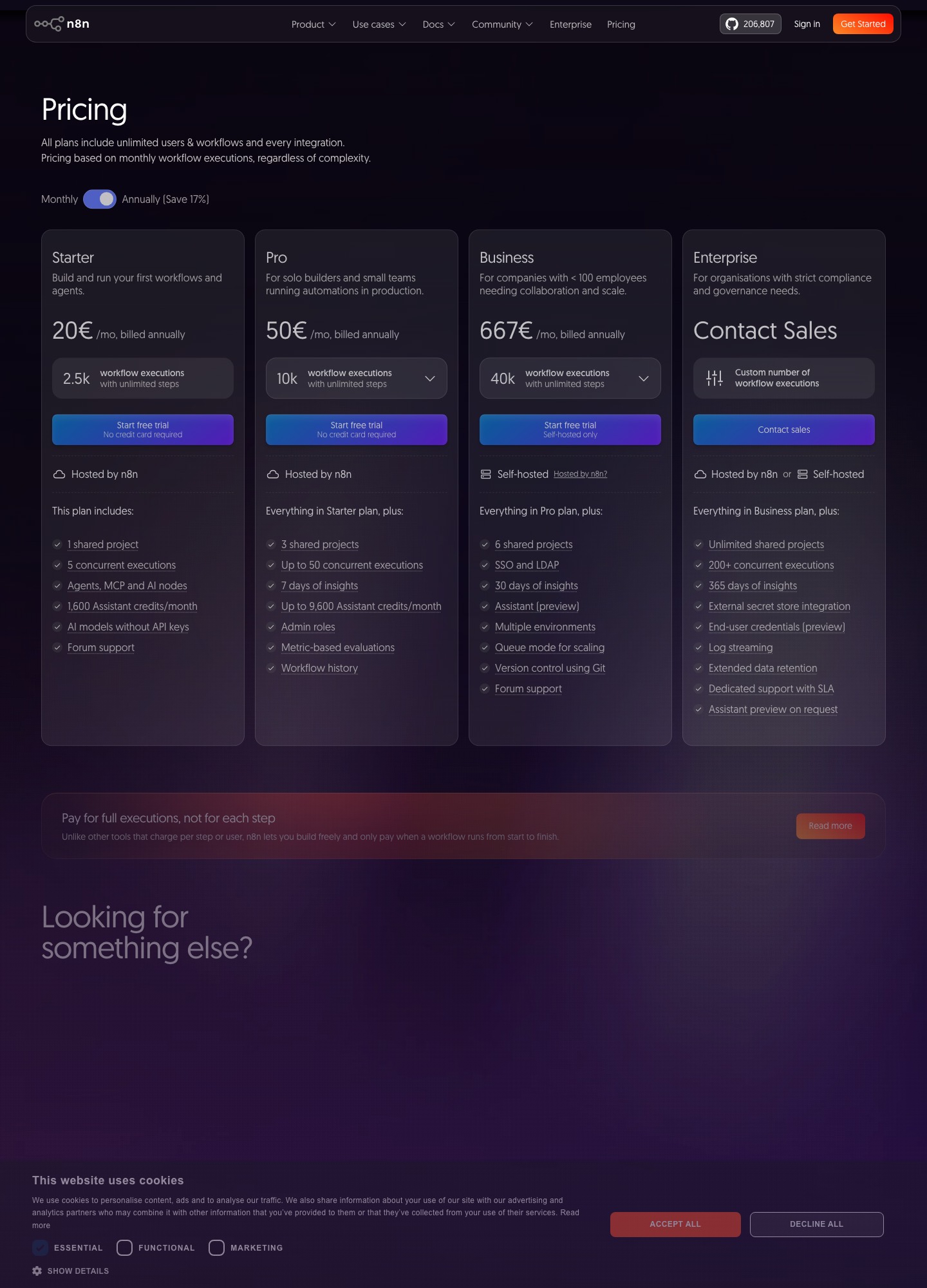
The four cards read Starter, Pro, Business and Enterprise, each with its execution count and a hosting line: "Hosted by n8n" for the first two, "Self-hosted" for Business, and "Hosted by n8n or Self-hosted" for Enterprise. The line under the page title says pricing is based on monthly workflow executions, regardless of complexity, and a toggle labelled "Annually (Save 17%)" sits above the cards.
Five replacements side by side
| Replacement | Unit and published price | The pull for an n8n user | The cost of the move |
|---|---|---|---|
| Zapier | Tasks: successful actions count, triggers do not. Free 100 tasks; Professional from $19.99/mo; Team from $69/mo with SAML SSO. | No servers at all, and SSO at a lower entry price than n8n Business. | Each added step adds tasks; overage is billed at a higher per-task rate. |
| Make | Credits per module action. 10k credits: $9, $16, $29/mo annual ($10.59, $18.82, $34.12 monthly). | Managed hosting with a cheap entry, and log search from Pro. | Scenarios stop when credits run out; no self-hosting; 30-day logs. |
| Activepieces | Credits. Free 1,000; Plus $20 for 10,000; Team $200 for 50,000; $0.007 per extra credit. | Cloud or on-prem on every plan, SSO and roles from the $200 Team plan. | Git sync, audit logs and SCIM sit in Ultimate, which is sales-led. |
| Pipedream | Usage credits, 1 per 30 seconds of compute. Startup $99/mo annual ($150 monthly): 10,000 credits, then $0.012 each. | Code steps, managed auth and external users for customer-facing integrations. | Production needs a paid plan; SSO and SCIM are Business-only. |
| Workato | Quote-based, four editions, task consumption tracked in a usage dashboard. | Environments, SAML SSO and role-based access in the first edition. | No self-serve price, and a sales cycle before you can test properly. |
A 3-step and a 12-step workflow at 2,500, 10,000 and 40,000 runs
n8n's meter ignores step count, so it is worth testing where that stops mattering. A short workflow (3 actions) and a long one (12 actions) both count as one execution per run on n8n. On Make each action is one credit, so the same runs use 3 or 12 credits each; Zapier would count tasks the same way for successful actions.
- 2,500 runs: n8n is 2,500 executions, exactly Starter's allowance, $20 a month billed annually, for either workflow. The 3-action version is 7,500 credits on Make, inside the 10k card at $9 billed annually, which is less than n8n. The 12-action version is 30,000 credits, past that card; Make's slider has labelled stops at 20k and 40k, but we did not read prices at them.
- 10,000 runs: n8n is 10,000 executions, which is Pro's allowance at $50 billed annually, for either workflow. Make would see 30,000 or 120,000 credits, and Zapier 30,000 or 120,000 tasks; neither vendor's page text we read gives a price at those sizes. Pipedream's Startup plan at $99 includes 10,000 credits, but credits there follow compute seconds, so the run count cannot be converted without timing your steps.
- 40,000 runs: n8n is 40,000 executions, which is Business at $800 a month billed annually, self-hosted only (or an Enterprise quote if you want n8n to host). Activepieces Team lists 50,000 credits for $200, but its page does not explain how a run turns into credits, so a trial is the only honest comparison.
Read that table sideways: for short workflows at moderate volume, Make Core is cheaper than n8n Starter, $9 against $20. For long workflows, or any volume that lands between Pro and Business, n8n's flat unit wins until the $800 step. If you sit at 15,000 executions, that step is the problem, since the published plans skip from $50 for 10K to $800 for 40K, and the Pro selector may or may not close the gap.
Matching your reason for leaving to a destination
You want hosting off your plate: Zapier or Make
Both are fully managed. Zapier's Team plan (from $69 a month) lists 25 users, shared connections and SAML SSO, which is the control n8n sells at $800 and self-hosted; its Free plan is 100 tasks and two-step Zaps. Make's Teams card at $29 billed annually for 10k credits adds team roles and shareable templates. You give up n8n's per-run meter, and long workflows get dearer at both. Our n8n vs Zapier page covers features in more depth, and Zapier vs Make separates those two.
You still want to self-host: Activepieces
Activepieces is the nearest like-for-like, with cloud or on-prem listed on all four plans and, for enterprises, running on your own servers or fully air-gapped. Team at $200 a month includes 25 users, SSO and standard roles, global connections and email support, against $800 for n8n Business. What you lose is the unit: credits rather than whole-workflow executions, and its pricing page does not describe execution history or retries, so confirm those in a trial. Git sync, audit logs and SCIM are Ultimate features.
You build integrations for customers: Pipedream or Activepieces Embed
Pipedream's page counts external users, with 100 included on Startup and $2 per extra user a month, plus managed auth for 3,000+ APIs. Activepieces separately lists an Embed offering from $36k a year with a white-label builder. Either is a cleaner fit than n8n if customers should connect their own accounts and build flows, which the community license rules out.
Procurement wants the checklist: Workato
Workato's first edition lists SAML SSO and MFA, role-based access control, dev, test and production environments, encryption at rest and in transit, and 30-day log retention, with 90 days flexible on Enterprise MCP. It claims 1,200+ pre-built connectors and unlimited users. You get no price until a quote, and concurrency starts at 1 on the lower editions.
When n8n remains the right answer
Keep n8n if your workflows are long, your volume sits comfortably inside a published tier, and someone on your team is happy to own a server or pay for Pro. A 12-step workflow run 10,000 times is $50 a month there, and none of the other pages we read publishes a price for that shape at that volume. Keep it also if the data must not leave your network and you have the infrastructure skills to stay on top of upgrades.
What the license says about building for your customers
n8n's community license page says the Sustainable Use License lets you use, modify and redistribute with three limits: use only for internal business purposes or non-commercial or personal use, distribute only free of charge for non-commercial purposes, and do not remove licensing notices. It also says n8n does not call itself open source. The license FAQ adds that the community license is free and applies to the self-hosted version only; n8n Cloud has its own terms.
- Allowed, per the FAQ: using n8n to help run your business, charging customers for workflow creation, setup, maintenance, training and consultancy, and using n8n behind the scenes in your own product where users can trigger the automations you built and even connect their own accounts.
- Not allowed: hosting n8n as a service and letting clients build workflows, letting external end users build or configure their own workflows through your product (the FAQ names a custom UI, the API, MCP or an AI agent acting for the user), forking it to launch an automation product, white-labelling it, and using enterprise features that ask for a license key without an Enterprise license.
- The FAQ's example of a SaaS platform with an embedded workflow builder, backed by n8n on the operator's server, is marked not allowed, and it points to an Enterprise license for that design. If that describes your roadmap, talk to n8n or choose a tool built for embedding before you commit.
We are reporting what the pages say and are not giving legal advice. The FAQ itself tells readers in doubt to email license@n8n.io.
Taking workflows out of n8n
n8n's export and import page says workflows are saved as JSON. From the editor's three-dot menu, Download gives the current workflow as a JSON file and Import from File reads one back; you can also copy and paste nodes. The page warns that exported workflow JSON includes credential names and IDs, and that HTTP Request nodes imported from cURL may contain authentication headers, so scrub the files before sharing them with a consultant or a new vendor.
- On a self-hosted install, the Server CLI offers n8n export:workflow and n8n export:credentials, with --all, --id, --separate (one file per workflow) and --backup (all, pretty-printed, separate). Adding --decrypted exports credentials in plain text, and the docs say all sensitive information is then visible in the files.
- The docs say exported items carry their IDs and that items with matching IDs are overwritten on import, and that import:workflow deactivates imported workflows by default. Those are notes for moving between n8n instances; the pages we read describe importing only into n8n, so a move to another vendor is a rebuild with the JSON as your specification.
- The same docs name the newer n8n CLI, with n8n-cli package commands that write a portable .n8np file. n8n says packages are in Preview and may change, and that it recommends this route over the Server CLI for new work.
- n8n export:entities writes all database entities so you can change database type; execution history data tables are excluded by default because they can be very large, and an option includes them. If auditors may ask for old runs, take that export before you shut the instance down.
FAQ
Which n8n plan includes SSO?
n8n's pricing page lists SSO and LDAP on Business at $800 a month billed annually, and that plan is self-hosted only. Enterprise, which can be hosted by n8n or self-hosted, is contact-sales. Zapier Team lists SAML SSO from $69 a month and Activepieces Team lists SSO at $200.
Is n8n free for a SaaS company?
The self-hosted Community Edition is free under the Sustainable Use License, for internal business purposes. The license FAQ says you may not let external end users build their own workflows through your product, so customer-facing builders need a different tool or an Enterprise agreement.
What counts as one n8n execution?
The pricing page says an execution is a single run of the entire workflow, and that it doesn't matter how many steps the workflow has or how much data it processes. A 12-step workflow run 2,000 times is therefore 2,000 executions against Starter's 2.5K allowance.
Can I move n8n workflows straight into Zapier or Make?
n8n documents exporting workflows as JSON and importing them into n8n. The pages we read do not describe importing that JSON into Zapier, Make or another vendor, so plan to rebuild each workflow and use the export as a reference for node order and settings.
Which alternative can I still self-host?
Activepieces lists cloud or on-prem hosting on every plan, from Free to Ultimate, and describes running on your own servers or air-gapped for enterprises. Pipedream, Make, Zapier, Workato and Tray state no self-hosted option on the pages we read, though Tray lists advanced on-premise on Enterprise and Workato describes an on-premises gateway.
All alternatives · Zapier alternatives · Make alternatives · n8n vs Zapier · Workflow automation tools · No-code automation