By Rowan Ellis · Updated October 7, 2026
Make alternatives for SaaS teams hitting credit and log limits
If Make is no longer the right fit, the four tools most SaaS teams try first are Zapier, n8n, Activepieces and Pipedream, while Workato and Tray are the picks when a security review and long log history matter more than the monthly figure. The reasons people leave Make are specific: scenarios stop dead when the credit allowance runs out, credits expire at the end of each term, the Free plan caps you at two active scenarios running no more often than every 15 minutes, and execution logs are kept for 7 to 30 days on everything below Enterprise. Prices were read from each vendor's pricing page on October 7, 2026.
Make is also the cheapest tool in this group at a small scale, so leaving it should be a deliberate move rather than a reflex. Below you will find what makes the credit meter bite, how a four-module scenario costs out at three volumes against Make's rivals, which alternatives keep logs longer or host differently, and what Make's blueprint export actually contains.
What drives people away from Make
Hitting the ceiling means stopping. Make's pricing page says that when credits run out, your scenarios won't continue to run until credits are added again. You can buy extra credits in bundles of 1,000 or 10,000 at the fixed price defined in your subscription, and Core, Pro and Teams offer auto-purchase, but the page text we read gives no per-credit overage figure. The Enterprise column lists overage protection as a feature, which tells you the lower plans do not have it.
Unused credits vanish. The page states that credits expire at the end of the term, and extra credits follow the same rule. A team with a quiet month pays the same and carries nothing over, whereas one with a spike has to top up mid-cycle. The FAQ also says credits became the billing unit as of August 27, replacing operations, which is worth knowing if you are reading older Make comparisons that talk about operations.
Free is genuinely limited. Free is $0 for up to 1,000 credits, with a maximum of 2 active scenarios, a 15-minute minimum interval between runs, a 5-minute maximum execution time and 7 days of execution log storage. It has no time limit, which is why people park prototypes there, but a production scenario that must react in under a quarter of an hour cannot live on it.
History is short. The log-retention row on the page reads 7 days on Free, 30 on Core, Pro and Teams, and 60 on Enterprise. Full-text search of the execution log starts at Pro. If a customer reports a failed sync from six weeks ago, Make cannot show you the run on any plan except Enterprise.
No self-hosting. The page lists hosting on AWS in the EU or North America and describes no option to run Make yourself. Teams whose security policy wants workflows inside their own network have to look elsewhere.
Make pricing as captured in October 2026
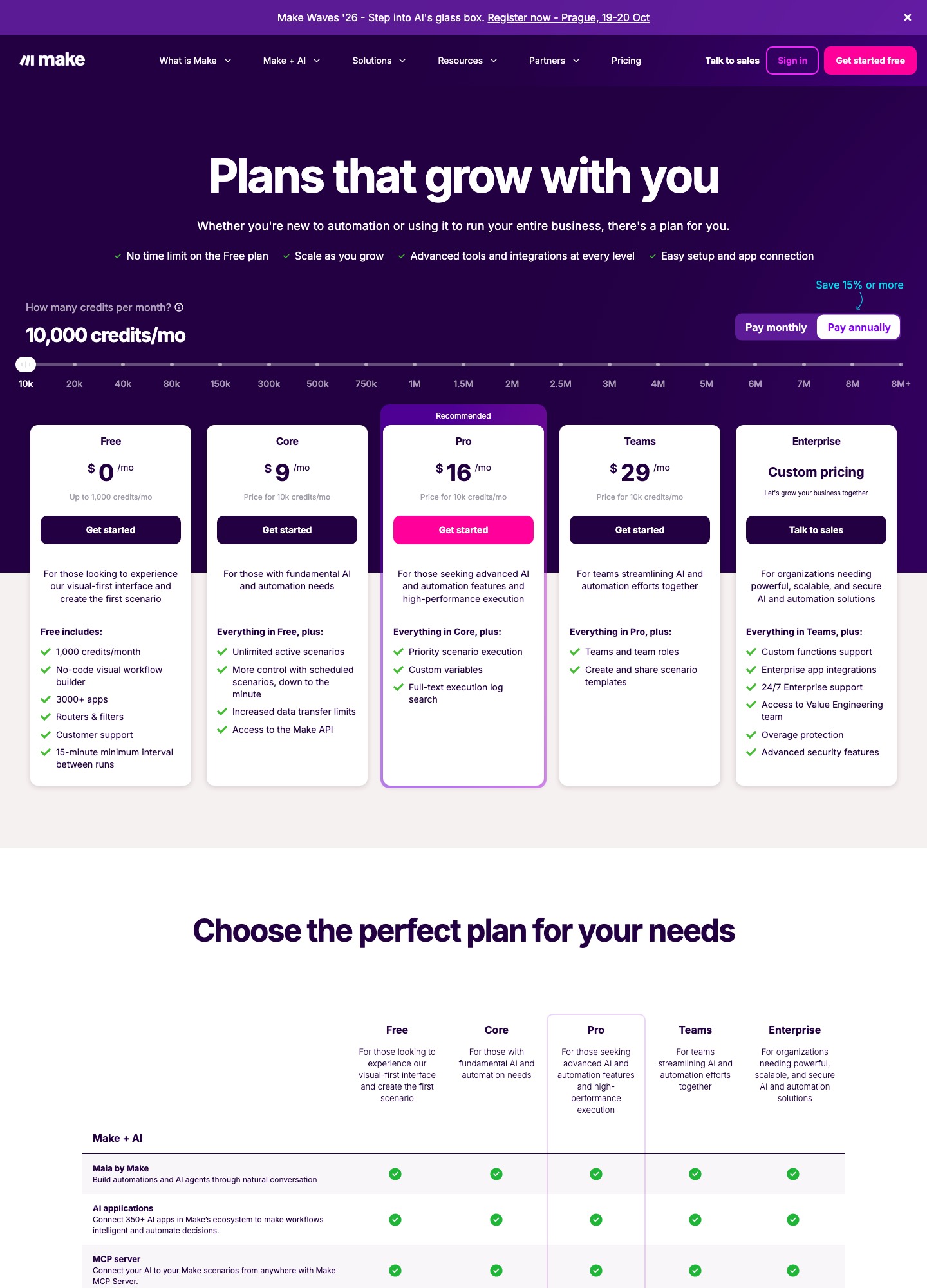
The slider sits at 10,000 credits and "Pay annually" is selected, so the cards read $0, $9, $16, $29 and custom pricing. With the monthly toggle the same cards are $10.59 for Core, $18.82 for Pro and $34.12 for Teams, and the page's "Save 15% or more" note checks out: $9 / $10.59 is about 0.85. Annual billing on Core therefore saves about $19 over twelve months ($127.08 monthly versus $108).
Six places to go instead
| Option | What it meters, and the published price | Why someone would pick it | What you lose |
|---|---|---|---|
| Zapier | Tasks (successful action steps; triggers free). Free 100 tasks; Professional from $19.99/mo; Team from $69/mo. | Largest integration catalogue (9,000+) and SAML SSO with shared connections on Team. | Past the allowance it bills pay-per-task at a higher rate; steps multiply tasks. |
| n8n | Workflow executions, steps unlimited. $20/mo for 2.5K, $50 for 10K, $800 for 40K, billed annually. | Heavy branching without per-step charges, and a self-hostable Community Edition. | Business, the tier with SSO and Git, is self-hosted only. |
| Activepieces | Credits. Free 1,000; Plus $20 for 10,000; Team $200 for 50,000; $0.007 each over. | Cloud or on-prem on all plans; Free credits reset daily instead of monthly. | Roughly twice Make Core's price at 10,000 credits, and audit logs wait for Ultimate. |
| Pipedream | Usage credits, 1 per 30 seconds of compute. Startup $99/mo annual or $150 monthly with 10,000 credits, then $0.012 each. | Code-first steps with 3,000+ connectors and unlimited team members on Free. | Free is development-only; production starts at Startup. |
| Workato | Quote-based. 30-day log retention on Standard, flexible 90 days on Enterprise MCP. | Environments, SAML SSO and role-based access in the first edition; usage dashboard. | Nothing to compare until sales quotes; concurrency starts at 1. |
| Tray | Quote-based; usage in Tasks. Plans Pro (3 workspaces), Team (20), Enterprise (unlimited). | Workspaces for separate departments, audit trails and observability on every plan. | Log retention starts at 7 days, shorter than Make Core's 30. |
A four-module scenario at 250, 2,500 and 25,000 runs
Suppose each run goes through four modules and Make counts one credit per module action, as its page says. We have not assumed anything about whether a trigger module adds a fifth credit, because the page text does not settle it. That gives 4 credits a run.
- 250 runs a month: 250 x 4 = 1,000 credits, exactly Make Free's allowance, so $0, subject to the 2-scenario and 15-minute rules. On Zapier the same four actions are 1,000 tasks against Free's 100, so Professional from $19.99 applies. n8n counts 250 executions, well inside Starter's 2.5K at $20 a month billed annually.
- 2,500 runs: 2,500 x 4 = 10,000 credits, the size of the 10k card: Core $9, Pro $16 or Teams $29 billed annually. n8n lands on 2,500 executions, which is Starter's ceiling to the unit, at $20. Zapier shows 10K as a labelled slider stop and the price behind it is not in the capture. Activepieces Plus covers 10,000 credits at $20, but its page does not say how many credits a single step uses.
- 25,000 runs: 25,000 x 4 = 100,000 credits. Make's slider has stops at 80k and 150k but none at 100k, so we cannot quote a figure. n8n counts 25,000 executions, beyond Pro's 10K; Business at $800 billed annually covers 40K but is self-hosted only. Pipedream and Activepieces cannot be sized without knowing credits per step, so the honest answer is to run your real scenario through a trial.
A second sum shows why the 15-minute interval matters on Free. If a scenario ran through all four modules on each of the 96 scheduled runs in a day (every 15 minutes), it would use 384 credits a day and the 1,000-credit allowance would be gone in under three days. Real scenarios usually stop early when nothing new arrives, so treat 384 as the ceiling rather than the forecast, and look at your own execution history before you decide.
Who each alternative suits, and the compromise involved
Zapier: simpler building, a different failure mode
Zapier's pricing page says tasks are used when a Zap successfully completes an action and that triggers don't count. Where Make stops at the limit, Zapier keeps running and bills pay-per-task at a higher rate than your base tasks, so a spike costs money instead of dropping work. Team (from $69) adds 25 users, shared connections and SAML SSO. You trade Make's cheap entry price and canvas-style routing for a longer app list. The Zapier vs Make page sets them side by side.
n8n: no meter on steps
n8n bills an execution as one run of the entire workflow, so a scenario that Make would count as four or forty credits is one unit. All plans include unlimited users and workflows. Starter allows 5 concurrent executions with forum support, Pro up to 50 and adds admin roles, and Business adds SSO and LDAP, environments, queue mode and Git. You take on a steeper learning curve if your builders live in Make's visual router, and more operational work if you self-host.
Activepieces: self-hosting without a custom quote
Activepieces lists cloud or on-prem on all four plans and allows up to 5 users on Free and Plus, 25 on Team. Its Free credits reset daily and the page says that going over waits for tomorrow, which is gentler than a monthly lock. At the 10,000-credit size Plus costs $20 against Make Core's $9 annual or $10.59 monthly, so choose it for hosting freedom, not for savings.
Pipedream: when the scenario is really code
If your Make scenarios have turned into chains of HTTP and JSON modules, Pipedream lets engineers write the steps directly and charges by compute time, 1 credit per 30 seconds. Startup is $99 a month billed annually ($150 monthly) with 100 external users and email support. Fast, light steps are cheap; long-running ones are not, and SSO and SCIM are Business-only.
Workato and Tray: for governance buyers
Both publish no prices, so neither can be compared on cost here. Workato's first edition already lists dev, test and production environments, SAML SSO and MFA, role-based access and 30-day log retention, matching Make's 30 days; Enterprise MCP's 90 days is the longer window. Tray's Pro keeps logs for 7 days, Team offers 7 days expandable plus log masking, and 30-day retention appears among its add-ons. Tray's Enterprise plan adds unlimited workspaces, SSO and HIPAA. For a head-to-head between the two, see Tray vs Workato.
Reasons to remain on Make
Make is the cheapest published entry in this list at 10,000 units: $9 on Core billed annually, and a Teams plan with team roles and shareable scenario templates is $29. If your scenarios are modest, scheduled every few minutes and your log needs fit within 30 days, nothing here beats it, and moving would cost rebuild time with no saving. Stay too if your builders are not engineers and like the visual canvas.
Taking scenarios with you: the blueprint file
Make's scenario blueprints page says a blueprint contains the scenario's modules, module settings and mapped values, and it is exported as a .json file from the three-dot menu in the Scenario Builder, using Export blueprint. The page lists backing up scenarios, in case you lose access to or switch to another Make account, as one use. Files are typically named after the scenario, followed by .blueprint.json.
- Connections are not in the file. The page says users still need to create connections for their own accounts after importing, so every app login has to be re-authorised.
- Import is the reverse (three dots, Import blueprint, Choose File, Save), and the file must be below 2 MB or the scenario cannot be saved. Make advises creating a new scenario first, because importing over an unsaved one loses its changes.
- The page says the clipboard copy can be pasted into other Make scenarios, LLMs or other compatible tools. It does not name another automation product that accepts blueprints, so assume a rebuild when you move to a different platform and use the JSON as documentation of module order and mappings.
- Execution logs are not among the items listed as blueprint contents. With 30 days of retention on paid plans, save any run history you need for audits before you cancel.
FAQ
What happens to my Make scenarios when credits run out?
Make's pricing page says scenarios won't continue to run until credits are added again. Extra credits come in bundles of 1,000 or 10,000 at the price set in your subscription, and incoming webhooks are queued up to the queue size while you are out.
Does Make still bill in operations?
No. The pricing page FAQ says that as of August 27 credits are the billing unit, replacing operations. Each module action counts as one credit, and error-handler modules such as Rollback, Break, Resume, Commit and Ignore are not counted.
How long does Make keep execution logs?
The pricing page lists 7 days on Free, 30 days on Core, Pro and Teams, and 60 days on Enterprise. Full-text execution log search starts at Pro, so Core is the one paid plan on the page without it.
Can I export Make scenarios and import them into Zapier or n8n?
Make's blueprint page describes JSON export and import within Make, with connections recreated by hand. It does not describe importing a blueprint into another vendor's product, so rebuild the workflow in the new tool.
Is anything cheaper than Make for 10,000 actions a month?
Among the prices published on these pages, no. Make Core is $9 a month billed annually for 10k credits, against Activepieces Plus at $20 for 10,000 credits and n8n Starter at $20 for 2.5K executions. Zapier Professional starts at $19.99, but its tasks and Make's credits are counted differently.
All alternatives · Zapier alternatives · n8n alternatives · Zapier vs Make · Tray vs Workato · Data automation tools · Automation integrations