By Rowan Ellis · Updated October 7, 2026
Pipedream alternatives for SaaS teams
The Pipedream alternatives worth testing are n8n and Activepieces if you want to self-host or cap the bill, Make and Zapier if your team prefers a visual builder, and Tray or Workato if a procurement team wants an enterprise platform. The reason to look is no longer only price. Pipedream's docs announce that Workflows and String shut down on March 31, 2027, with all Workflows data deleted by April 30, 2027, while the pricing page now describes Pipedream Connect, the toolkit for adding integrations to your own product. Prices below were read from each vendor's pricing page on October 7, 2026.
So there are two kinds of Pipedream customer reading this. If you run internal automations, code steps and webhooks as Pipedream workflows, you are on a clock and need a new home. If you use Connect to let your customers link their own Slack, Google or CRM accounts, the notice says Connect settings and credentials are not affected, and your question is whether the per-credit, per-user meter still suits you. We cover both: what drives people away, what 10,000 to 200,000 credits cost against the alternatives, and what Pipedream's export actually hands you.
What is pushing teams off Pipedream
Workflows has an end date. The Workflows page in the docs now carries a notice: Workflows are in maintenance mode, Pipedream is no longer accepting signups or subscriptions for them, and no new features will ship. Existing workflows keep running through March 31, 2027. Subscriptions stay active until that date, when they are cancelled automatically with a prorated refund. The credentials and OAuth tokens for connected accounts are deleted along with the workflow data by April 30, 2027. The notice explains the decision as a focus on being the integration layer that connects AI to outside systems.
Production is priced as an embedded product. Pipedream's pricing page offers a Free plan where every feature works in development only, then Startup at $99 a month billed annually or $150 billed monthly. Startup includes 100 users and 10,000 usage credits, then $2 per extra user and $0.012 per extra credit. That is a good shape for a product with a small number of connected customers and an awkward one when the user count is high but each person triggers little work, since the $2 applies either way.
A credit measures compute time. The pricing page defines a usage credit as 1 credit per 30 seconds of compute for running an action, calling an MCP tool, making a Connect proxy request or emitting an event from a deployed trigger. A slow API call therefore costs more than a fast one, and the page does not say how a partial 30-second block is rounded. Compare that with n8n, which charges per whole workflow run, or Make, which counts each module action.
Governance sits on the custom plan. Single sign-on, SCIM provisioning, HIPAA, dedicated static egress IPs and SLAs are marked Business-only on the pricing page, and Business is an annual contract with custom pricing. Startup's support is email. A SaaS team that needs SSO for its staff will not find it at $99.
The page says little about operations. The pricing page does not describe execution history, retries or error handling, and it states no self-hosting option. Pipedream's overview docs do mention logs, errors and timing for every step, so this is a gap in the page, not necessarily the product, but it means plan limits on history are something to ask about before you decide.
The pricing page as captured in October 2026
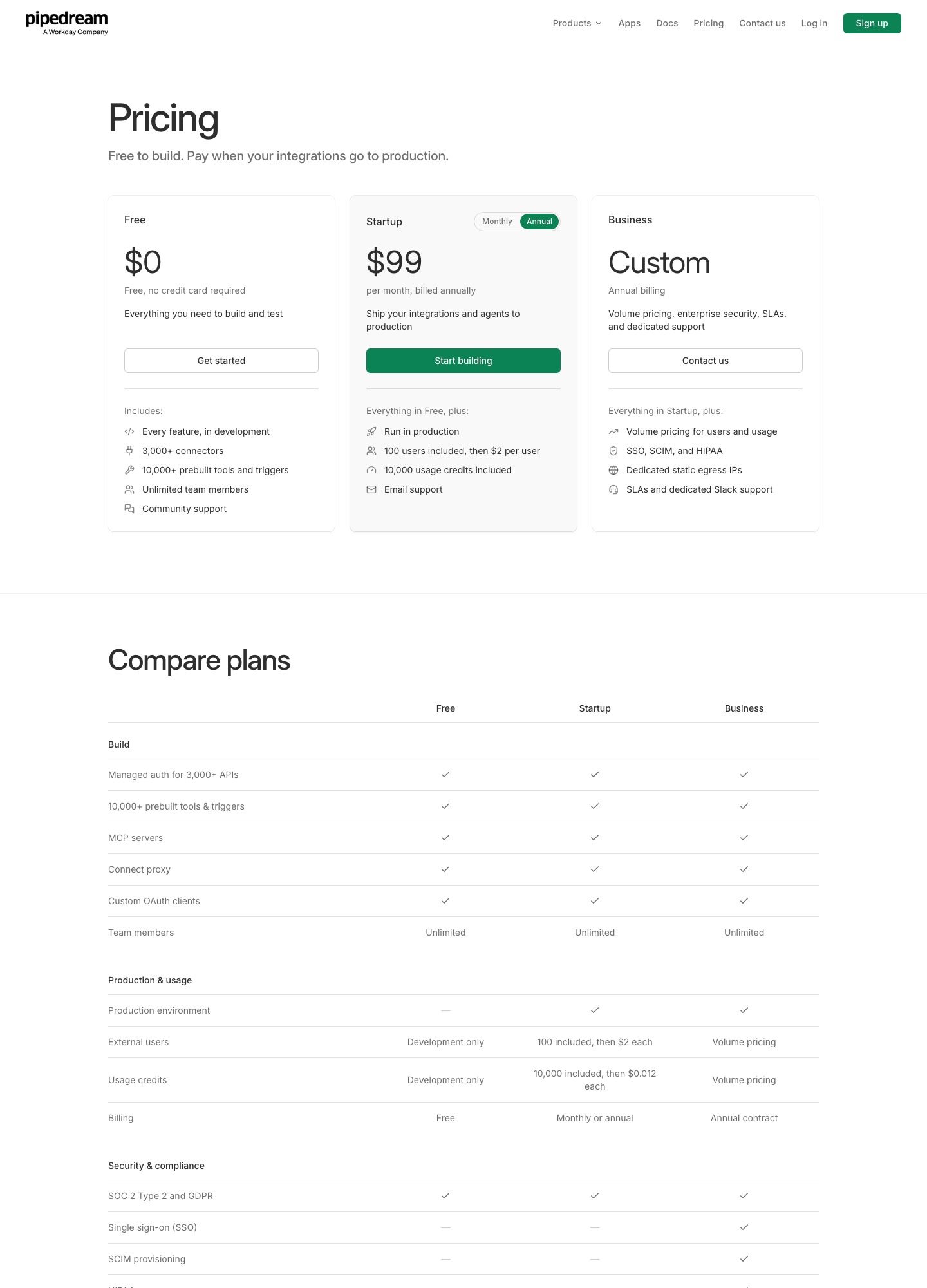
The capture shows the headline "Free to build. Pay when your integrations go to production", the three cards (Free $0, Startup $99 with an Annual toggle, Business Custom) and the start of the plan comparison, where production environment is a dash under Free. It does not mention the Workflows shutdown; that notice lives in the docs.
Six places to move, compared
| Alternative | Unit and published price | Suits | The catch |
|---|---|---|---|
| n8n | Workflow executions, whatever the number of steps. Starter $20/mo for 2.5K, Pro $50/mo for 10K, Business $800/mo for 40K, all billed annually. A self-hosted Community Edition is on GitHub. | Developers moving internal workflows who want to run the engine themselves. | No free hosted plan, and Business is self-hosted only. Its page prices executions, not your customers connecting accounts. |
| Activepieces | Credits. Free with 1,000; Plus $20/mo with 10,000; Team $200/mo with 50,000 and 25 users; $0.007 per credit over. Embed from $36k a year. | Teams wanting an open, white-label builder inside their own product, on cloud or on-prem. | The Embed price is a very different budget line from Pipedream Connect, and SCIM, audit logs and Git sync are Ultimate-only. |
| Make | Credits, one per module action. At the 10k-credit setting: Core $9, Pro $16, Teams $29 a month billed annually ($10.59, $18.82, $34.12 monthly). Free has 1,000 credits. | Ops and growth people building visual scenarios on a small budget. | Scenarios stop when credits run out, credits expire at term end, and the page states no self-hosting. |
| Zapier | Tasks, counted when an action succeeds. Free 100 tasks; Professional from $19.99/mo; Team from $69/mo with 25 users and SAML SSO; Enterprise by quote. | Non-developers who want the widest app list (9,000+ apps). | Overage is billed at a higher per-task rate, and the page shows no offer for embedding in your own product. |
| Tray | Tasks. Pro, Team and Enterprise all route to a demo or sales; no prices are shown. | Companies that need governed integrations across departments and partners, and are ready for a budget conversation. | No number to plan against before a sales call. |
| Workato | Platform edition plus usage. Standard, Business MCP, Enterprise MCP and Workato ONE are listed with no prices. | Large organisations that want an enterprise platform with an on-premises gateway. | Its page says plan structures vary with contract terms and when you joined. |
Costs at 10,000, 50,000 and 200,000 credits
Pipedream's meter has two dials, credits and external users, so the sums below set both. The user figures are an assumption for illustration; use your own.
- 10,000 credits, 100 users: exactly what Startup includes, so $99 a month billed annually ($1,188 a year) or $150 billed monthly ($1,800).
- 50,000 credits, 250 users: (50,000 - 10,000) x $0.012 = $480 for credits, plus (250 - 100) x $2 = $300 for users. On the annual rate that is $99 + $480 + $300 = $879 a month; on monthly billing, $150 + $480 + $300 = $930.
- 200,000 credits, 1,000 users: 190,000 x $0.012 = $2,280 for credits and 900 x $2 = $1,800 for users, so $99 + $2,280 + $1,800 = $4,179 a month ($4,230 billed monthly). At that size the page's Business card is the other option, and it lists volume pricing for users and usage without a figure.
Now the same loads elsewhere, in each vendor's own unit, which are not interchangeable. Activepieces: 10,000 credits is Plus at $20; 50,000 is Team at $200; 200,000 is Team plus 150,000 x $0.007 = $1,050 over, so $1,250 a month. Its users are workspace members, so the 1,000 end users do not enter that sum. n8n: 10,000 executions is Pro at $50 a month billed annually; 40,000 is Business at $800; its page shows no price for 50,000 or 200,000 short of an Enterprise quote. Make: Core is $9 a month at 10,000 credits, and bigger sizes sit on a slider whose readings we have not captured, so no figure here. Zapier, Tray and Workato publish nothing at these volumes.
One workflow run changes the maths by unit. A flow with ten steps is one n8n execution, roughly ten Make credits, and a compute-time charge on Pipedream. Count your own busiest workflow before comparing totals.
Which way to go
n8n for code-minded internal automation
Pipedream's docs list Node.js, Python, Go and Bash for code steps. We did not confirm n8n's equivalent on the pages we read, so test your own scripts in a trial first. What its pricing page does give you is a billing unit that ignores step count, an annual Pro plan at $50 for 10K executions and a self-hosted edition on GitHub. Business at $800 a month adds SSO and LDAP, queue mode and Git version control, but only self-hosted, so you also take on hosting and upgrades. If your Pipedream usage is webhooks and glue code rather than customer-facing connections, this is the closest fit. Our n8n vs Zapier page covers the pair head to head.
Activepieces when you want the builder inside your app
It is the one on this list that names an embedding offer with a price: Embed from $36k a year with a white-label builder. Hosting is cloud or on-prem on every plan, Team adds SSO and 25 users for $200 a month, and the Free plan has 1,000 credits and unlimited flows. You give up the cheap on-ramp: Pipedream Connect starts at $99 a month on annual billing, so $1,188 a year against $36,000, about thirty times as much, though the products differ in scope.
Make or Zapier for teams that do not write code
Make's Core at $9 a month (10k credits, annual billing) is the lowest entry on this page, with unlimited active scenarios, minute-level scheduling and API access. It keeps execution logs for 30 days on paid plans. Zapier starts the Team plan at $69 and lists 9,000+ apps. Neither pricing page describes an offer for your own customers to connect their accounts. See Zapier vs Make if you are choosing between those two.
Tray or Workato for enterprise procurement
Both publish features without prices. Tray's Enterprise card lists unlimited workspaces, SSO, HIPAA, regional hosting and 180-day insights; Workato's pricing page lists SAML SSO and MFA even on Standard, with 30-day log retention. Expect a sales process for either. We compare them directly on Tray vs Workato.
When staying with Pipedream is right
If what you run is Connect, adding managed auth and tools for your own users, the shutdown notice is about Workflows, and the notice states Connect settings and credentials will not be affected. $99 a month for 100 users and 10,000 credits is hard to beat on the numbers above. One loose end: the Connect docs still have a page on running workflows for your end users, so ask Pipedream whether that part is covered by the Workflows shutdown before you build on it.
Getting your workflows out of Pipedream
Pipedream built an export tool for the shutdown. It downloads a ZIP per project, with one JSON file per workflow describing triggers, steps, code, configured props and control-flow branches, plus a manifest.json. The docs frame the output as a record and a reference for rebuilding on another platform, and the pages we read name no importer, so plan to recreate each workflow by hand using the JSON as your spec.
- The export covers the latest deployed version only. Workflows that were never deployed are listed in manifest.json as skipped, and so are workflows beyond the limit of 500 workflows or 256 MB per export; split the project and export again.
- Exports run one project at a time, and a project holds one export at a time: to re-export, delete the existing project_export zip from the File Store first.
- Secret props, environment variables and HTTP auth objects come out as
<redacted>. Connected accounts keep only an identifier, so every OAuth connection is made again on the new platform. - Event history, data stores and File Store files are not in the archive. Download what you need before April 30, 2027.
- The code of private multi-file components is not exported, only its key.
The alternative route is GitHub Sync, which serializes a project's workflows to YAML in a repo. Its FAQ says there is no published definition of that YAML yet, and legacy v1 workflows are not supported in projects, so for a move to another vendor the JSON export is the better-documented path.
FAQ
Is Pipedream shutting down?
Part of it. The docs say Pipedream Workflows and String shut down on March 31, 2027, with Workflows data deleted by April 30, 2027. The same notice says Pipedream Connect settings and credentials are not affected. Read the notice for your own case.
What does Pipedream cost in production?
The pricing page shows Startup at $99 a month billed annually or $150 billed monthly, with 100 users and 10,000 usage credits. Extra credits are $0.012 each and extra users $2 a month. Business is custom, with SSO, SCIM, HIPAA and SLAs.
Can I import my Pipedream export into n8n or Make?
The export docs describe the JSON as a record of what you built and a reference for rebuilding, and they do not mention an importer for other products. Expect to recreate triggers, steps and connections by hand, and to re-enter every secret.
Which Pipedream alternative can I self-host?
n8n offers a Community Edition on GitHub, and its Business plan is self-hosted only. Activepieces lists cloud or on-prem hosting on every plan. Tray lists advanced on-premise under Enterprise. Pipedream's pricing page states no self-hosting option.
What replaces Connect if my customers link their own accounts?
Of the pages we read, Activepieces is the one that prices an embed offering (from $36k a year, white-label builder). Tray's docs mention white-labelling custom OAuth apps for embedded integrations, and Workato's docs list an Embedded section. None of the three is priced like Connect's $99 start.
All alternatives · Workato alternatives · Tray alternatives · n8n vs Zapier · Workflow automation tools · Automation for startups