By Rowan Ellis · Updated October 7, 2026
Tray.ai alternatives for teams that want visible pricing
Teams that look for Tray.ai alternatives usually end up comparing Workato for the same enterprise tier, n8n and Activepieces for published prices and self-hosting, and Make or Zapier for lighter team automation. Pipedream Connect belongs on the list only for embedded integrations. What sets people looking is on Tray's own pricing page: Pro, Team and Enterprise each lead to a demo or a sales call, usage is metered in Tasks with no stated rate, and several governance items are sold as add-ons. Prices for the alternatives were read from their pages on October 7, 2026.
The rest of this page covers what Tray's plan cards say they include, six places to go with their pricing models, worked costs at 5,000, 25,000 and 100,000 units a month for the options that publish a price (Tray itself does not, so nothing is estimated for it), and what Tray's documentation says about exporting your projects.
What Tray's page says, and what it leaves blank
No price anywhere on the plan cards. On Tray's pricing page, Pro and Team end in a Get a demo button and Enterprise in Talk to sales. The only commercial hint is a line saying you choose a plan and add-ons, then scale with Tasks that cover integration, automation, MCP and agents. There is no per-task rate and no overage price. The site header also carries a Start free trial button, which we did not test.
Visibility is tiered. Pro lists 3 workspaces, 7-day insights and 7-day log retention. Team lists 20 workspaces, 30-day insights and 7-day expandable log retention. Enterprise lists unlimited workspaces and 180-day insights. A 30-day log retention option and a 180-day insights option also appear in the add-ons list, so a team that needs a month of logs on a lower plan should ask what that costs.
Security items are also add-ons. HIPAA, SSO and regional hosting are named in the Enterprise card and repeated in the additional add-ons list, next to Tray IDP, data engineering and log streaming. Team says all add-ons are available for purchase, which suggests a mid-tier plan can be extended, but the price of each stays behind the sales call.
Support is a second purchase. The page describes Tray Advantage as standard support with documentation and community access on every plan, and Tray Advantage Plus as enhanced support for faster resolution and dedicated resources, with 24/7/365 support, enhanced SLAs and a dedicated Slack channel listed alongside.
The connector list is shorter. Tray advertises 700+ connectors on all plans. Workato's pricing page says 1,200+, Pipedream's says 3,000+, Make's 3000+ and Zapier's 9,000+. Counts are marketing numbers and not a measure of coverage, but if your stack has long-tail apps, check each name in the vendor's catalog rather than trusting the total.
Tray's pricing page in October 2026
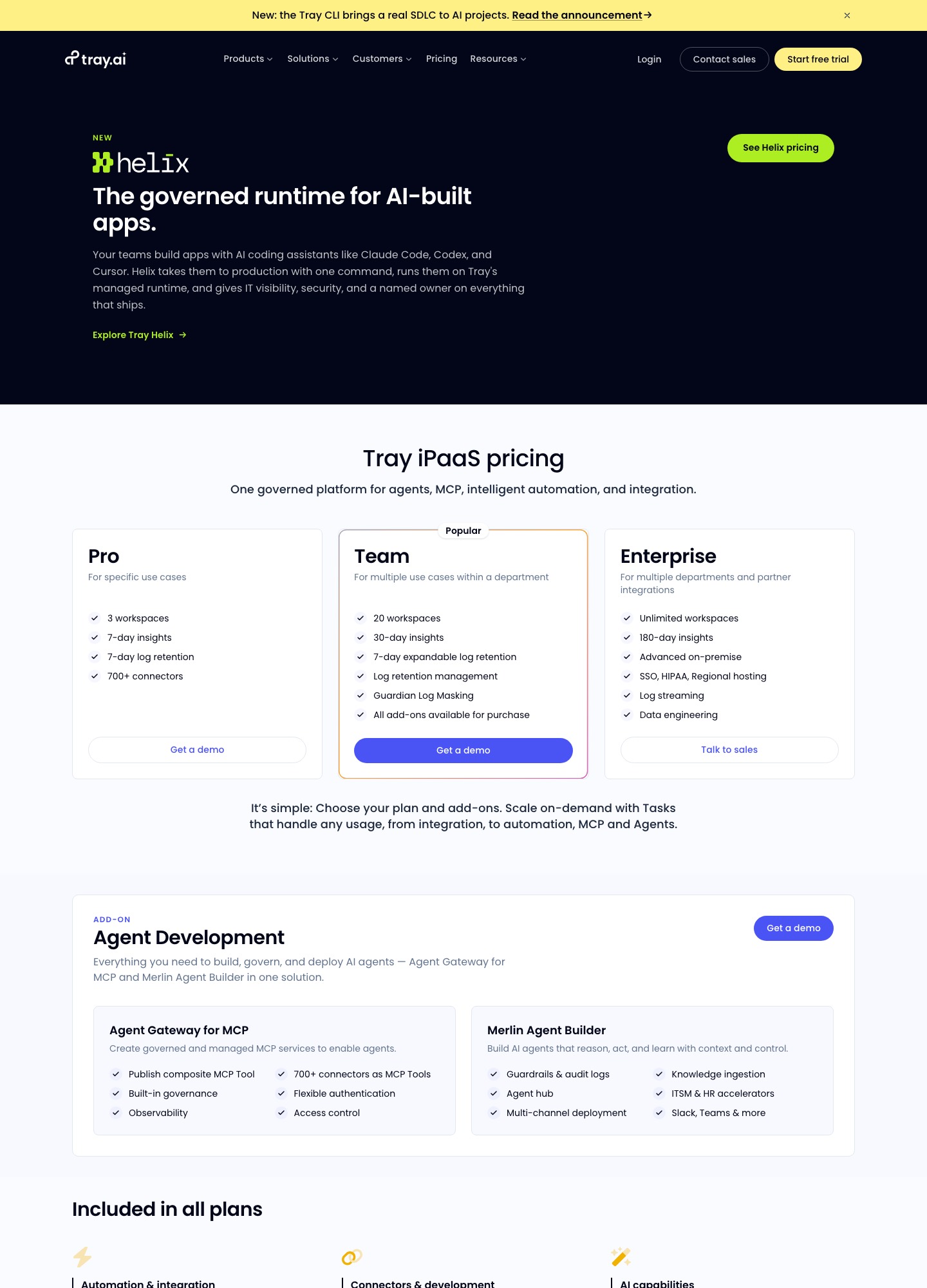
Along with the three cards, the capture shows a banner about a Tray CLI, a Helix section with its own "See Helix pricing" button that we did not review, and an Agent Development add-on covering an Agent Gateway for MCP and the Merlin Agent Builder. Our comparison sticks to the iPaaS plans.
Six options and how each one bills
| Option | Pricing signal | Hosting stance | Pick it when |
|---|---|---|---|
| Workato | Four editions (Standard, Business MCP, Enterprise MCP, Workato ONE) with no prices; usage is added on top. | On-premises gateway and OPAs; no self-hosted option stated. | You want a like-for-like enterprise platform and a second quote for leverage. |
| n8n | Per workflow execution. $20, $50 and $800 a month billed annually for 2.5K, 10K and 40K. | Community Edition on GitHub; Business self-hosted only; Enterprise hosted by n8n or yourself. | You want to run it yourself and bill by runs, not steps. |
| Activepieces | Credits. Free 1,000; $20 for 10,000; $200 for 50,000; then $0.007 per credit. Embed from $36k a year. | Cloud or on-prem on every plan; its page also describes running on your own servers or fully air-gapped. | You need hosting control or a white-label builder, and want a price on the page. |
| Make | Credits per module action. For 10k credits: $9, $16, $29 a month billed annually, or $10.59, $18.82, $34.12 monthly. | Hosted on AWS in EU or North America; no self-hosting stated. | A visual builder and a small first invoice matter most. |
| Zapier | Tasks. Team from $69 a month; Professional from $19.99; Enterprise quoted. | Hosted; the page lists SAML SSO on Team. | Business teams want the broadest app coverage and have no developers. |
| Pipedream Connect | Credits and users. Startup $99/mo billed annually ($150 monthly) for 10,000 credits and 100 users. | Page states no self-hosting. Docs say Workflows end March 31, 2027. | You only need embedded auth and tools for your own users. |
The arithmetic where there is a price
Tray publishes no figure at any volume, so it is absent from the sums. Each line below is in the vendor's own unit: n8n counts executions of a whole workflow, Pipedream meters compute time in credits, and Make, Activepieces and Zapier count module actions, credits and tasks. Treat the lines as orders of magnitude.
- 5,000 a month: n8n needs Pro ($50, 10K executions) because Starter stops at 2.5K. Activepieces Plus is $20 for 10,000 credits. Make Core is $9 billed annually for 10k credits. Pipedream Startup is $99 annually or $150 monthly, with 10,000 credits inside.
- 25,000 a month: Activepieces Plus runs $20 + (25,000 - 10,000) x $0.007 = $20 + $105 = $125, which is below Team's flat $200. Pipedream: $99 + 15,000 x $0.012 = $279 (or $330 on monthly billing), with 100 users included. n8n jumps to Business: $800, since Pro is capped at 10K and Business covers 40K. Make's page gives readings only for 10k credits, so no figure.
- 100,000 a month: Activepieces Team: $200 + 50,000 x $0.007 = $550, against $20 + 90,000 x $0.007 = $650 on Plus; the two plans cross near 35,700 credits. Pipedream: $99 + 90,000 x $0.012 = $1,179 ($1,230 monthly). n8n would be an Enterprise quote. Zapier shows only a starting price of $69 for Team.
Two things stand out. n8n's price steps from $50 to $800 between Pro and Business, so check where your volume sits, because 10K to 40K executions is a sixteen-fold price change on the pricing page. And per-credit pricing of $0.007 on Activepieces against $0.012 on Pipedream is not a fair comparison until you know how many credits one of your workflows burns.
Going deeper on each option
Workato, if you want to stay in the enterprise tier
Workato's page lists SAML SSO, role-based access and dev, test and production environments from Standard, and unlimited workspaces and users. It does not give a price either, so moving gains you leverage and a different feature mix, not transparency. See Workato alternatives for its own limits and Tray vs Workato for the side-by-side.
n8n and Activepieces for self-hosting
Tray's Enterprise card lists advanced on-premise but its page does not state a self-hosted deployment. n8n's Community Edition and Business plan are self-hosted by design, and Activepieces says cloud or on-prem on all four plans. The cost of that control is staffing: someone owns upgrades, backups and queue capacity. n8n Business adds SSO, LDAP, queue mode and Git; Activepieces Team adds SSO with 25 users.
Embedded integrations without Tray
If you use Tray to power integrations your customers see, two published routes exist. Activepieces lists Embed from $36k a year with a white-label builder, and Pipedream Connect offers managed auth for your users from $99 a month with $2 per user beyond 100. Tray's own docs say custom OAuth apps are mainly used to white-label logos and URLs in Embedded integrations, and that they can only be created in the workflow editor. Make, Zapier and n8n show no embedded offer on the pages we read.
Make and Zapier for business-owned automations
For departments that outgrow spreadsheets but do not need governed pipelines, Make's $9 Core plan and Zapier's $69 Team plan with SAML SSO are a fraction of an enterprise commitment. You lose workspaces, log masking and HIPAA options. Our Zapier vs Make page covers the choice between them.
Reasons to stay with Tray
Stay if you are mid-rollout, if the workspaces and 180-day insights on Enterprise are what your platform team asked for, or if you depend on the agent tooling shown on the capture. Switching an enterprise integration estate is a project with its own cost, and the sales process is only one of the reasons to leave.
What Tray lets you take with you
Tray's Import / Export page says projects and individual workflows export as JSON files, to move between Orgs or between workspaces in the same Org. It frames this as development-to-production promotion. On the pages we read, Tray does not describe loading an export into another vendor's product, so expect to use the JSON as a map for rebuilding.
- A project export includes workflows, project configuration, solutions, data tables, vector tables, API management operations and basic agent metadata, in each case as a definition only.
- Stored rows in data tables and vectors in vector tables do not move, and API management policies and roles do not either; export your data separately.
- An agent moves as its name, instructions, and the tools and workflow it references. The links to its subprojects do not travel, so a moved agent is incomplete until those exist.
- Export a saved project version when you can. The page recommends it for promotion because a version is a fixed snapshot, whereas exporting the current state can include half-finished edits. For one workflow, use the three-dot menu in the builder and choose Export workflow.
- Data tables, vector tables, API management operations and agents are moved through the UI or the Tray Sync CLI, since the public Projects and Solutions API endpoints do not move them.
- The environment setup page says services, connectors and authentications must be mirrored in the target, and that custom services must be mapped on first import. Credentials are not among the exported items the Import / Export page lists, so plan to reconnect your apps.
FAQ
How much does Tray.ai cost?
Tray's pricing page shows Pro, Team and Enterprise with no prices, each routed to a demo or sales contact. Usage is metered in Tasks, and the page states neither a task rate nor an overage price.
Does Tray have a free trial?
The site header has a Start free trial button, but the plan cards themselves say Get a demo or Talk to sales. We did not test the trial, so confirm its limits and what carries over before you build anything in it.
What is the cheapest published alternative at 25,000 units a month?
Activepieces Plus works out to $125 (a $20 base plus 15,000 extra credits at $0.007), and Pipedream Startup to $279 on the annual rate. n8n lands at $800 on Business. Units differ, so test one real workflow before trusting the ranking.
Can I move Tray workflows into Workato or Make?
Tray exports JSON files, but the pages we read describe importing them into Tray projects and workspaces, not into other products. Plan on rebuilding workflows by hand and reconnecting every authentication.
Can Tray be self-hosted?
The pricing page does not state a self-hosted option; Enterprise lists advanced on-premise. For self-hosting that is clearly described, n8n offers a Community Edition and Activepieces lists cloud or on-prem on each plan.
All alternatives · Workato alternatives · Pipedream alternatives · Tray vs Workato · Automation for enterprise · Workflow automation tools