By Rowan Ellis · Updated October 7, 2026
HubSpot alternatives for SaaS teams that want lifecycle email without the CRM bill
If the reason you are leaving HubSpot Marketing Hub is the price of unlimited automation, look first at ActiveCampaign, Customer.io, Encharge and Brevo; if it is the CRM side you want to change, Pipedrive and Salesforce are the usual destinations. The common pain points are a leap from $7 to $800 a month between plans, send limits tied to your marketing-contact tier, and product-event data that only unlocks at the top plan. Prices below were read from vendor pages on October 7, 2026.
The useful question is rarely "which tool is better than HubSpot" but "which half of HubSpot am I actually using". Many SaaS teams run the CRM happily and only need better lifecycle messaging; others pay for a CRM their sales team ignores. This page splits those cases.
Where the HubSpot pricing page draws its lines
- The gap between Starter and Professional. The Marketing Hub pricing page lists Free, Starter at $7 a month, Professional at $800 and Enterprise at $3,600. Starter allows up to 10 automated actions; Professional is where actions become unlimited and omni-channel automation (up to 300 workflows) begins. There is no tier between $7 and $800, so one extra branch in a nurture flow can mean a 114-fold price increase ($800 / $7).
- Email sends follow the contact tier. The page expresses limits as a multiple of your marketing-contact tier: 5 times on Starter, 10 times on Professional and 20 times on Enterprise. If your tier were 10,000 marketing contacts, that is 50,000, 100,000 and 200,000 sends a month. The free plan stops at 2,000 sends a month and carries HubSpot branding.
- Product events sit at the top. Custom events, with up to 500 event definitions and 30 million completions a month, are listed only under Enterprise at $3,600 a month, along with workflows that use behavioural events. Starter segmentation is limited to form-submission data, contact properties and marketing email activity, which is awkward if your usage data lives in your own database.
- AI work is metered. The page says HubSpot Credits power agents and AI features, bought in packs or pay-as-you-go. The capture lists 5,000 included credits a month on Starter and 10,000 on Professional, so a feature you try can quietly become a line item.
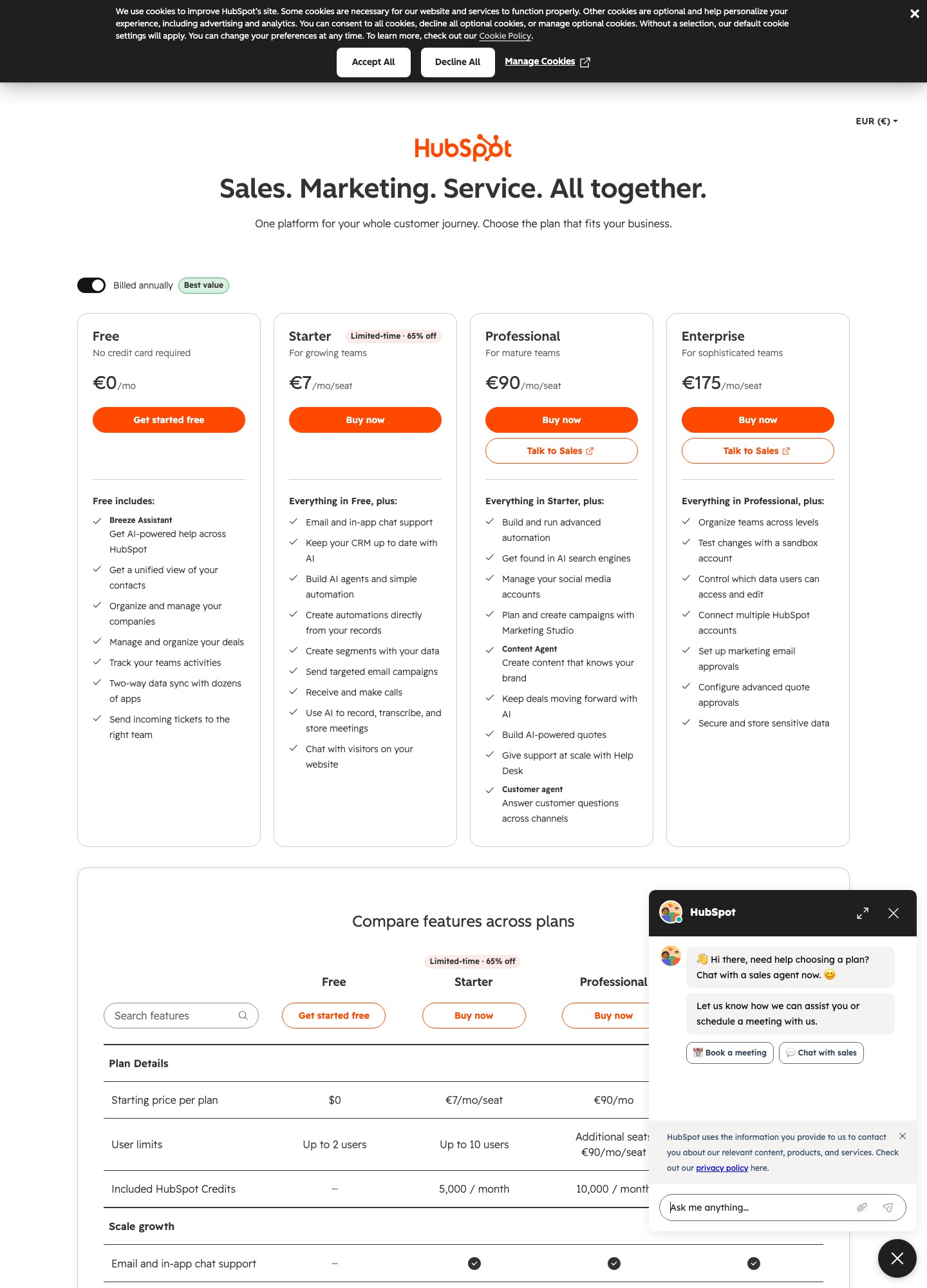
One oddity worth knowing before you compare: our capture was taken from a European location and shows HubSpot's all-in-one view, with Starter at €7, Professional at €90 and Enterprise at €175 per seat per month, billed annually. The dedicated Marketing Hub page above lists $7, $800 and $3,600 a month. The plan names match but the tables do not, so confirm which one you are quoted before you build a business case.
Six places to go, compared
| Destination | Cost and billing unit | Why a HubSpot user would pick it | What you lose |
|---|---|---|---|
| ActiveCampaign | Plus $49, Pro $79 a month at 1,000 contacts (annual billing); Starter $149 at 10,000 per its own article | Unlimited automation actions from Plus, with deals in the same tool | Custom objects only on Enterprise, and billing follows the contact count |
| Brevo | Standard $18 a month from 5,000 emails; Professional $499 from 150,000 | Cheap automation with SMS and WhatsApp alongside | Volume-based tiers; custom objects are Enterprise-only |
| Customer.io | Essentials $100 a month for 5k profiles, $145 at 10k, billed monthly | Messages triggered by product events, with objects as profiles | No CRM, so sales needs another home |
| Encharge | Growth $99 a month for up to 2,000 subscribers; Premium $159, which lists HubSpot and Salesforce connections | Keep HubSpot as the CRM and move lifecycle flows out | Per-subscriber price climbs: Growth is $249 at 10,000 |
| Pipedrive | Lite $14, Growth $39, Premium $59, Ultimate $79 per seat a month, billed annually | A sales-first CRM with email sequences on Growth | Not a lifecycle email engine for product users |
| Salesforce | Starter Suite $25 per user a month; Pro Suite $100, Core $195 (billed annually) | CRM governance for larger sales organisations | More to configure, and a per-seat model |
Three real situations, priced
One or two people, light automation
HubSpot is at its best here: Free is $0 with 2,000 sends a month and one automated action, and Starter is $7 with up to 10. ActiveCampaign Starter is $15 at 1,000 contacts, Brevo Standard is $18 for 5,000 emails and Pipedrive Lite is $14 per seat, though Pipedrive's automations and email sequences only begin on Growth at $39. Staying put is reasonable unless the CRM clutters your workflow.
5,000 contacts and a need for unlimited automation
HubSpot Professional is $800 a month, or $9,600 a year ($800 x 12). Customer.io Essentials is $100 for 5k profiles ($1,200 a year) and Encharge Growth is $179 for 5,000 subscribers ($2,148 a year). The gaps are $700 and $621 a month. ActiveCampaign's capture only shows the 1,000 step (Plus $49, Pro $79), so there is no number for it here. Professional also bundles social, ads and SEO tools, so the saving only counts if you were not using them.
10,000 contacts and product events
The headline Enterprise price is $3,600 a month ($43,200 a year), and its email sends are sized as 20 times your contact tier. Customer.io is $145 at 10k profiles ($1,740 a year), and Encharge Premium is $399 at 10,000 subscribers ($4,788 a year) with 100 times your subscriber limit in monthly events. If the main reason to be on Enterprise is event-driven messaging, the gap is the whole case for leaving. The $0.009 charge for extra Customer.io profiles is an extra to budget for.
Keep the CRM, move the email: how each option plays out
Encharge Premium is the cleanest split. Its pricing page lists HubSpot and Salesforce integrations along with a transactional email API, so you can leave the CRM alone and rebuild only the lifecycle flows. You pay $159 a month at 2,000 subscribers, or $129 billed yearly, and Encharge adds $100 for each 100,000 emails over its allowance.
Customer.io suits teams whose messages depend on product behaviour: its Essentials plan counts people and objects as profiles, includes 1 million emails and a visual workflow builder, and the pricing page mentions a Startup Program giving a year free to companies that raised under $10M. It does not replace a sales pipeline.
ActiveCampaign is the nearest all-in-one swap if you want CRM deals and automation under one roof for far less than $800. Our ActiveCampaign alternatives page covers where that plan runs out. Brevo is the budget route, with automation from $18; read its limits first.
Pipedrive and Salesforce answer a different question. Pipedrive's Growth plan at $39 a seat adds automations and nurturing sequences, and Salesforce Starter Suite at $25 a user spans sales, service, marketing and commerce. Five seats cost $195 a month on Pipedrive Growth ($39 x 5, billed annually) or $125 on Salesforce Starter Suite ($25 x 5), but neither replaces behavioural email on its own. Pair them with one of the tools above, and see our Pipedrive vs HubSpot and Salesforce vs HubSpot comparisons for the CRM side.
The case for staying with HubSpot
If sales, marketing and support all work in the same records, the CRM and email sharing one database is worth something. The free tier covers contacts, companies and deals, and Starter at $7 is inexpensive for a small team. Staying also avoids rebuilding workflows: HubSpot's own export notes say there is no way to merge data between HubSpot accounts, so the cost of leaving is real. Only move when the Professional jump, the contact-tier send limits or the Enterprise-only events actually block something you need.
What HubSpot lets you take with you
- Contacts and deals: Export your records works from the All view of any object, as CSV, XLS or XLSX. By default only the properties and associations in your view are included; Customize lets you export all properties, or all properties plus associations. You get an emailed download link that expires after 30 days. Limits: 300 exports in a rolling 24 hours, three at once, CSVs over 2MB are zipped, and XLS stops at 256 columns, so use CSV for wide exports.
- Unsubscribes: exporting all contacts includes unsubscribes. To leave them out, filter where "Unsubscribed from all email" is not equal to True. For migration, you usually want them, so your new tool can suppress them from day one.
- Lists: HubSpot now calls them segments. Export segments handles active or static ones with the properties you tick, but associated records are not included. To keep associations, export a view instead.
- Workflows: the export your content and data hub describes a spreadsheet of workflow details (name, active status, enrollment and goal counts, creator, type) and a PNG image of each workflow. It does not include performance data, the workflow history or data from emails used in the workflow, so the image is your blueprint for rebuilding.
- Before you cancel: the same hub warns that forms lose their paid features once the account is deactivated, so replace embedded forms first, and that legacy CTAs stop working. It also lists export articles for marketing email performance, recipient data and hard bounces and unsubscribes.
FAQ
Why does HubSpot jump from $7 to $800 a month?
On the Marketing Hub pricing page, Starter at $7 limits email automation to up to 10 actions and a 5x contact-tier send limit. Professional at $800 offers unlimited actions, 10x sends and up to 300 omni-channel workflows. There is no plan in between, which is why many teams compare external tools at the $100 to $250 level instead.
Can I keep HubSpot as my CRM and move only the email?
Yes, and Encharge Premium is built for it: its pricing page lists HubSpot and Salesforce connections on the $159 plan. You export nothing from the CRM, you rebuild the lifecycle flows in the new tool, and you sync contact properties back and forth. HubSpot's free tier also remains available for the CRM.
How do HubSpot send limits work?
Starter allows 5 times your marketing-contact tier in emails per calendar month, Professional 10 times and Enterprise 20 times. For a 10,000-contact tier that is 50,000, 100,000 and 200,000 sends. The free plan is capped at 2,000 sends with HubSpot branding.
What is the cheapest unlimited-automation alternative?
On the pages we read, ActiveCampaign Plus is $49 a month at 1,000 contacts, Encharge Growth is $99 for 2,000 subscribers and Customer.io Essentials is $100 for 5k profiles. They are priced on different units, so match the plan to your list size, and remember none of them includes HubSpot's social, ads or SEO tools.
Which of my HubSpot data will not come across?
Workflow exports leave out performance data, history and email data, and segment exports leave out associated records. Notes, calls and other activities are separate exports, and workflow logic itself has to be rebuilt by hand from the PNG images.
Related: all alternatives, Pipedrive vs HubSpot, Salesforce vs HubSpot, HubSpot vs Marketo, Pardot vs HubSpot, marketing automation tools, sales automation tools.