By Rowan Ellis · Updated October 7, 2026
ActiveCampaign alternatives for SaaS teams outgrowing contact-based pricing
For a SaaS team the shortlist is Customer.io or Encharge if messages should fire on what users do inside the product, MailerLite or Brevo if the monthly bill is the complaint, and HubSpot Marketing Hub if sales wants the pipeline next to the email. People tend to leave ActiveCampaign for one of three reasons: the price tracks the list, the cheap plan caps what an automation can do, or the tool is organised around contacts and tags rather than accounts and product events. All prices below were read from vendor pages on October 7, 2026.
Vendors here bill in different units (contacts, profiles, subscribers, monthly emails), so every figure names its unit and whether it is a monthly or annual rate. This is a page about switching, so ActiveCampaign's own price gets a short summary and the rest of the space goes to where you might land and what moving costs you.
What pushes SaaS teams away from ActiveCampaign
A price attached to the size of the list
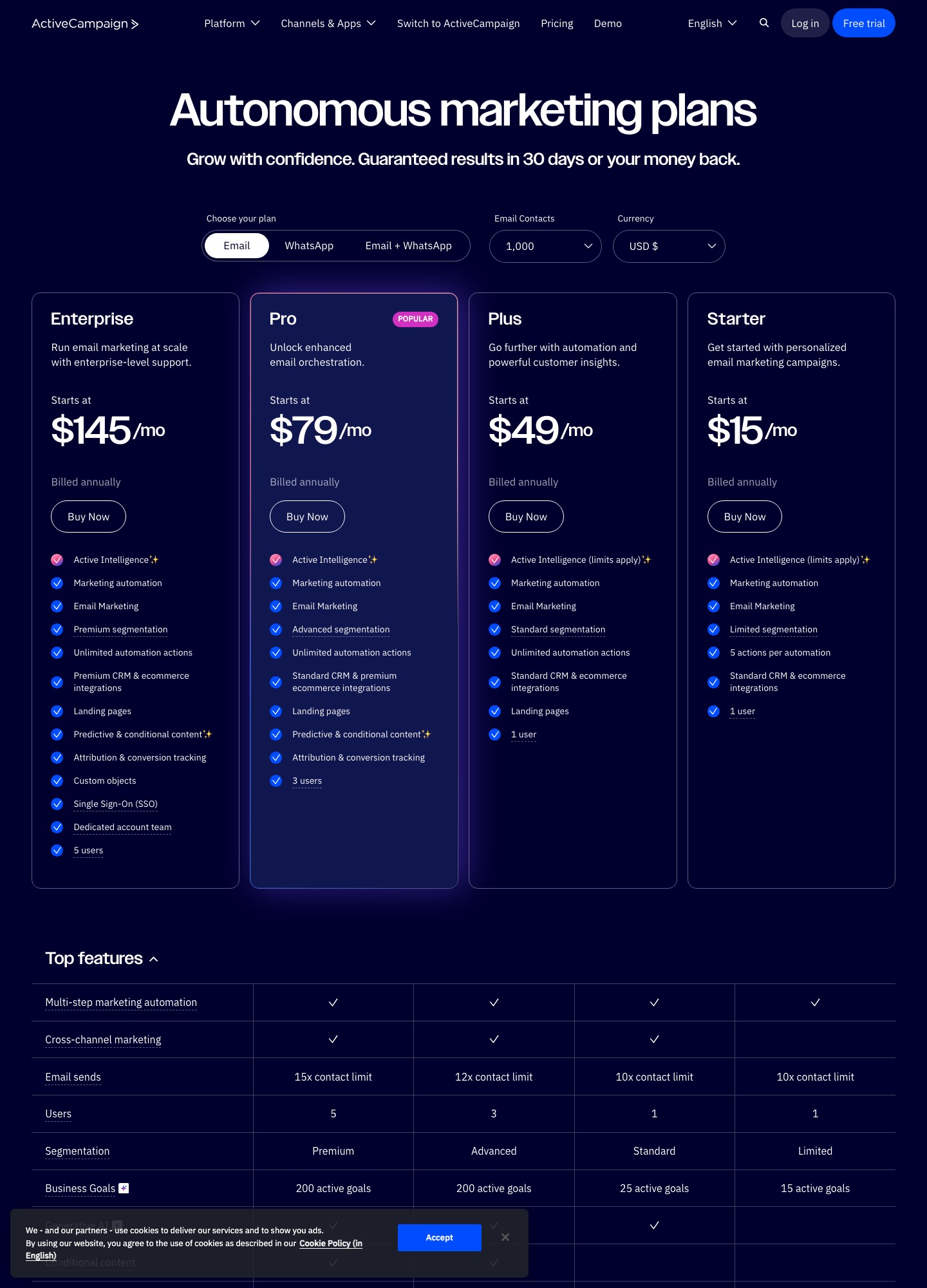
ActiveCampaign's pricing page shows Starter at $15 a month, Plus at $49, Pro at $79 and Enterprise at $145, all billed annually, with the contact selector at 1,000. The selector is the point: change it and every number moves. In its own March 2026 article on pricing at 10,000 contacts, ActiveCampaign puts Starter at $149 a month. That is $15 a month for 1,000 contacts and $149 for 10,000, roughly 1.5 cents per contact at both sizes, so the rate never tapers as you grow.
Unsubscribed people can still count
The help article on contact limits splits accounts by date. Accounts created on or after November 3, 2025 count every contact toward the limit whatever its status; accounts created on or before November 2, 2025 count only active contacts. A SaaS list that has collected years of churned trial users makes that distinction expensive if your account is the newer kind.
The small plans really are small
The pricing page gives Starter 1 user, limited segmentation and 5 actions per automation, and the help article on automation actions repeats the five-action ceiling. A trial onboarding series with a welcome email, a wait, a tag, a second email and a goal check reaches five steps quickly, if each step counts as an action. The capture below also shows 15 active goals on Starter against 25 on Plus and 200 on Pro. Unlimited actions begin at Plus.
Account-shaped data sits on the top plan
SaaS messaging often needs to know about the workspace, the plan and the seat count, not only the person. In the same capture, "Custom objects" appears only on the Enterprise card, which starts at $145 for 1,000 contacts and comes with 5 users. Customer.io's pricing page, by contrast, counts "people + objects" as profiles and includes 2 object types on its $100 Essentials plan.
Six alternatives side by side
| Alternative | What it costs (billing unit) | Fits | The real trade-off |
|---|---|---|---|
| Customer.io | Essentials $100 a month for 5k profiles, billed monthly; $145 at 10k; Premium from $1,000 | Journeys driven by product events and object data | The entry price is $100, not $15, and there is no deal pipeline |
| Encharge | Growth $99 a month for up to 2,000 subscribers ($79 billed yearly); Premium $159 | SaaS teams that want visual behaviour flows | Costs more per subscriber than ActiveCampaign at 10,000 ($249 against $149) |
| Brevo | Free at 300 emails a day; Starter $9 and Standard $18 a month from 5,000 emails | Teams whose list is large but mailed lightly | Priced on email volume, so frequent senders climb steeply |
| MailerLite | Free at 250 subscribers; Comfort $19 and Power $39 a month at 1,000 subscribers | Newsletter-plus-automation, low budget | No transactional email of its own; thinner CRM |
| GetResponse | Starter $19 and Marketer $59 a month for 1,000 people ($15.58 and $48.38 yearly) | Funnels and segmentation for a similar bill | Starter allows one automation workflow, so only Marketer is comparable |
| HubSpot Marketing Hub | Free (2,000 sends a month); Starter $7; Professional $800 a month | Teams that want CRM and email together | Unlimited automation starts at the $800 tier |
What each list size costs
Working from the vendor pages, at three list sizes. ActiveCampaign's prices are annual-billing rates; MailerLite, Encharge and Customer.io figures are the monthly-billed rates their pages list, so compare with that gap in mind.
1,000 contacts
- ActiveCampaign: Starter $15, Plus $49, Pro $79 a month, or $180 a year for Starter ($15 x 12).
- GetResponse: $15.58 (Starter) and $48.38 (Marketer) on annual billing, which sits next to ActiveCampaign Starter and Plus.
- MailerLite: Comfort $19 and Power $39 a month at 1,000 subscribers.
- Brevo: 1,000 contacts mailed four times a month is 4,000 emails, inside the 5,000-email step, so Standard is $18 a month.
- Encharge and Customer.io: their smallest listed steps are 2,000 subscribers ($99) and 5,000 profiles ($100), so they cost more than ActiveCampaign at this size.
5,000 contacts
ActiveCampaign's capture only shows the 1,000 step, so there is no figure here for it. MailerLite lists Comfort at $49 and Power at $69; Encharge Growth is $179 and Premium $269; Customer.io Essentials is $100 for 5k profiles and includes 1 million emails a month. Brevo's Standard stays at $18 if you send 5,000 emails or fewer a month, though its calculator also shows a contact-storage setting, so confirm the quote for a 5,000-person list.
10,000 contacts
ActiveCampaign Starter is $149 by its own article. Customer.io Essentials is $145, MailerLite Comfort $89 and Power $129, and Encharge Growth $249 and Premium $399. Look at the rate per person: Customer.io works out at 2.0 cents per profile at 5k ($100 / 5,000), 1.45 cents at 10k and 1.01 cents at 50k ($505 / 50,000), and MailerLite Comfort falls from 1.9 cents at 1,000 to 0.89 cents at 10,000 ($89 / 10,000). ActiveCampaign Starter stays near 1.5 cents.
Where each one fits, and what you give up
Customer.io for event-driven lifecycle
The pricing page lists a visual workflow builder, email and push, in-app messaging and 1 million emails a month on the $100 Essentials plan, with extra profiles at $0.009 each. Companies that have raised under $10M can take the Startup Program, a year free. You give up the built-in CRM: there is no Deals board, so a sales team that lives there will want something alongside. Choose it when your triggers come from your own application.
Encharge, built around the SaaS funnel
Encharge describes itself as "pricing that scales with your SaaS business" and sets event allowances at 50 times your subscriber limit on Growth, 100 times on Premium. Premium adds HubSpot and Salesforce connections and a transactional email API. The cost is the per-subscriber rate noted above, and email overages are $100 for every 100,000 sent. Pick it if trial-to-paid flows are the main workload and a flow builder matters more to you than the lowest price.
Brevo when the list is large and quiet
Free covers 300 emails a day. Standard at $18 adds automation and A/B testing. The model rewards a long list that is mailed occasionally and penalises a short list mailed daily, because volume sets the tier. Marketing automation does not appear until Standard, so the $9 Starter is a newsletter plan.
MailerLite and GetResponse for lower bills
MailerLite's free plan allows 250 subscribers and 2,500 emails a month with 2 seats, and Power gives unlimited emails from $25 a month at 500 subscribers. Its page says transactional email comes from MailerSend, a separate product. GetResponse Marketer adds unlimited workflows, advanced segmentation and abandoned-cart recovery. Neither pricing page we read lists product-event triggers, so they suit a SaaS that mostly sends marketing sequences.
HubSpot Marketing Hub if sales owns the list
The free tier sends up to 2,000 emails a month with HubSpot branding, and Starter at $7 allows up to 10 automated actions. The step to Professional at $800 a month is the one that removes the cap. See our HubSpot alternatives page before choosing it, since that jump is the reason many teams leave HubSpot.
When staying put is the better call
If your automations are already built, the list is under a few thousand active contacts and you use Deals and email in one tool, the move is mostly cost and risk. ActiveCampaign's article says it charges once per unique contact however many lists or tags that person is on, which keeps the bill predictable. At 1,000 contacts, Plus at $49 and Pro at $79 are below the smallest steps listed for Encharge ($99) and Customer.io ($100), and far below HubSpot Professional ($800), for unlimited automation actions. Reconsider when list growth or the Starter ceilings start to hurt.
What moving out of ActiveCampaign takes
- Contacts: export all contacts gives a CSV with the fields you tick, custom fields, lead scores and deal scores. Each contact's tags land in one column, so splitting them is on you. Contact notes cannot be exported, the download link lasts 7 days, and special characters in the export name turn the file into a text document.
- Lists and status: export a list lets you choose Active, Unconfirmed, Unsubscribed, Bounced or Any (Active is the default). Export unsubscribed and bounced separately so your new tool suppresses them, and keep the subscribed and unsubscribed date columns.
- Deals: export deals produces a CSV with deal ID, title, value, currency, status, owner, pipeline, stage, primary contact, account and dates. You need export permission, deal notes cannot be exported, the link expires after 30 days, and the List All Deals API returns up to 100 per page.
- Automations: the documented route is a share link that another ActiveCampaign account imports. It is a snapshot of the automation and its messages; campaigns, lists, scores, deals, pipelines and events are not included. On the pages we read there is no file you can load into a different vendor, so plan to rebuild each journey by hand.
FAQ
Does ActiveCampaign bill for contacts who have unsubscribed?
It depends on when the account was created. ActiveCampaign's help article says accounts created on or after November 3, 2025 count every contact toward the limit, while earlier accounts count only active ones. Check the creation date before pruning your list to save money.
Can I export my ActiveCampaign automations to another email tool?
The help center describes a share link, and it works between ActiveCampaign accounts. The shared copy carries the automation and its messages but not lists, tags, scores, deals or pipelines. For any other vendor you will rebuild each automation, so screenshot every journey and note the triggers and waits before you cancel.
Which alternative is cheapest at 10,000 contacts?
On the pages we read, MailerLite Comfort is $89 a month at 10,000 subscribers against $149 for ActiveCampaign Starter, Customer.io is $145 at 10k profiles and Encharge Growth is $249. The plans are not equivalent: MailerLite has no product-event triggers, while Customer.io includes 1 million emails a month.
Will my deals and pipeline move with me?
Only as spreadsheet rows. The deals export is a CSV, so a CRM such as Pipedrive or HubSpot would need to import it and rebuild the stages. Deal notes are excluded from the export, so copy any you need by hand before cancelling.
How soon do the export download links expire?
Contact and list exports are available for 7 days. Deal exports stay on the Import/Export Status page for 30 days. Run the exports early and save the files somewhere outside the account.
Related: all alternatives, Brevo alternatives, HubSpot alternatives, Mailchimp vs ActiveCampaign, Klaviyo vs ActiveCampaign, email automation tools.